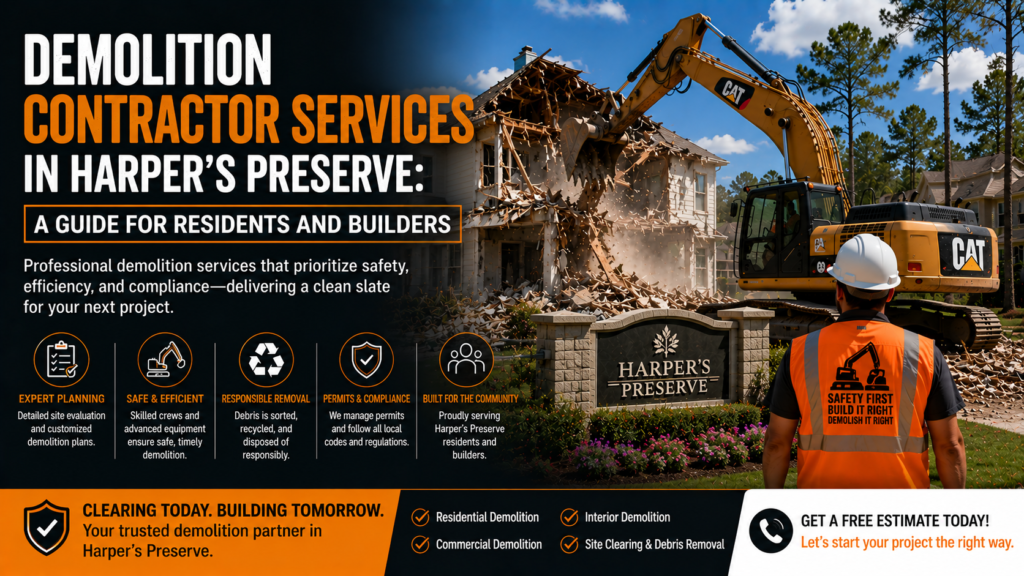
Harper’s Preserve is a distinctive master-planned community in Conroe, Texas, located approximately five miles northeast of The Woodlands and 30 miles north of downtown Houston. Developed by Sam Yager Incorporated with a design philosophy centered on coexistence with nature, Harper’s Preserve is organized around a 160-acre forested preservation area a protected wetland and wildlife habitat that serves as the community’s ecological heart. The community features more than 2,100 single-family homes, two full-scale amenity centers, an extensive trail system, and its own elementary school, as well as a burgeoning commercial district known as Harper’s Downtown.
The integration of natural preservation into the community’s design makes Harper’s Preserve a particularly thoughtful built environment and one where demolition and construction activities must be conducted with special care to protect the community’s environmental assets and aesthetic standards.
The Role of Demolition Contractors in Established Communities
In a community like Harper’s Preserve, Demolition Contractor Harpers Preserve serve property owners who are renovating, expanding, or modifying their homes; developers and builders working on new phases of the community; and commercial operators within Harper’s Downtown who may be reconfiguring retail or restaurant spaces. Demolition is rarely a standalone event it is typically the precursor to something new and better. Understanding the range of demolition services available, and the professional standards that govern them, empowers residents to make informed decisions when planning property improvements.
Types of Demolition Work in Harper’s Preserve
Interior Selective Demolition: As Harper’s Preserve homeowners personalize and upgrade their homes, interior demolition is frequently required. This includes removing partition walls to create open floor plans, demolishing outdated kitchens and bathrooms in preparation for renovations, taking out old flooring systems, and stripping interiors down to the stud when full gut renovations are planned. Interior demolition contractors work carefully within the structural footprint of the home to avoid damage to adjacent spaces, systems, and finishes.
Exterior Structure Removal: Outbuildings, old sheds, deteriorated decks, fencing, and concrete improvements such as driveways and patios are common subjects of exterior demolition in residential communities. As homeowners in Harper’s Preserve develop their outdoor spaces, removing existing improvements is often a necessary first step.
Pool and Spa Demolition: Swimming pool removal is a specialized service that demolition contractors provide using either full excavation (complete removal of the pool shell and surrounding concrete) or partial demolition and fill methods. Both approaches require permitting from the City of Conroe, and the choice of method depends on the homeowner’s plans for the land and local regulatory requirements.
Foundation and Concrete Work: Old concrete slabs, retaining walls, and driveway aprons require mechanical demolition equipment typically excavators equipped with hydraulic breakers and concrete pulverizers to remove efficiently and safely.
Land Clearing and Site Preparation: As new phases of Harper’s Preserve continue to develop, land clearing demolition prepares raw tracts for homebuilder activity. This involves removing existing vegetation, old structures, and surface improvements while carefully protecting the preservation areas and natural buffers that define the community’s character.
Environmental Sensitivity in a Preserved Community
The 160-acre forested preservation area at the heart of Harper’s Preserve is not just a marketing feature it is a protected ecological resource. Demolition contractors working in and around Harper’s Preserve must be especially sensitive to the proximity of this preservation area and to the broader network of natural features, stormwater drainage systems, and wildlife habitats that define the community. Responsible demolition practices include preventing soil erosion and sediment runoff during site work, avoiding disturbance of protected vegetation buffers, managing dust to prevent particulate matter from reaching sensitive natural areas, and properly disposing of or recycling all demolition debris.
Texas environmental regulations, along with any deed restrictions and HOA guidelines specific to Harper’s Preserve, govern how demolition and construction activities can be conducted near sensitive natural areas.
Hazardous Material Management
Even in a relatively new community like Harper’s Preserve where most homes have been built since the community’s founding in the 2010s hazardous materials can occasionally be encountered. Underground storage tanks from previous agricultural or industrial uses of the land, unexpected asbestos-containing materials in older construction components, and contaminated soils from prior land uses may all require specialized handling. Professional demolition contractors are trained to identify these issues, coordinate with environmental specialists, and ensure that any hazardous materials are managed in full compliance with Texas Commission on Environmental Quality (TCEQ) standards.
The Importance of HOA Compliance in Demolition Projects
Harper’s Preserve is a private, gated community with active HOA governance. The HOA establishes and enforces architectural and community standards that apply to all modifications and improvements within the community including demolition activities. Property owners undertaking demolition projects should review HOA guidelines regarding work hours, contractor access, debris management, and the protection of community common areas before work begins. Reputable demolition contractors familiar with master-planned communities will be aware of these requirements and will plan their work accordingly.
The Connection Between Demolition and Construction Quality
One of the most important things to understand about demolition is that its quality directly affects the quality of everything that follows. A poorly executed demolition one that leaves hidden structural damage, unaddressed utility conflicts, or improperly disposed waste creates compounding problems for the construction phase. Conversely, a well-planned and professionally executed demolition creates a clean, safe, and well-documented starting point for renovation or new construction, saving time, money, and stress throughout the project.
Conclusion
Harper’s Preserve represents a vision of community living that carefully balances development with natural preservation. Demolition contractors who serve this community operate in a context that demands not just technical skill but environmental responsibility, regulatory compliance, and respect for the community’s aesthetic and ecological standards. Whether supporting a homeowner’s renovation vision or helping prepare new development phases, professional demolition work is an integral part of how Harper’s Preserve continues to grow and thrive while honoring the natural landscape at its core.